Certificate of Authorship
A PDF artifact suitable for split sheets, publisher submissions, and contract attachments. Signed, timestamped, and linked back to its live InkID record.
The pause before the line. The revision after.
Every co-writer, signing in their own hand.
Every moment, anchored to a time stamp that no one can alter.
Available on iPhone. Live on the web today.
For two hundred years, a songwriter proved authorship the same way.
The system was built for a world where writing a song was hard, slow, and unmistakably the work of a person.
That world ended.
We built InkWave for the one that came after.
the proof you wrote a song came after.
the proof is the writing.
Every session is captured. Every line is attributed. Every co-writer signs in their own cryptographic hand. The whole creative motion of writing a song is recorded — and anchored, the moment it happens, to an independent timestamp no one — not a publisher, not a court, not the future — can move.
The act of writing, and the proof of writing it,
the same thing.
You already wrote it.
The proof was being written alongside it.
This is what authorship looks like in the age of AI.
A songwriting app — with proof of authorship built in.
Available on iPhone · Live on the web today
A late session. A song that isn't done. Every block — verse, chorus — captured as it's written, ready to be anchored when the writer says so.
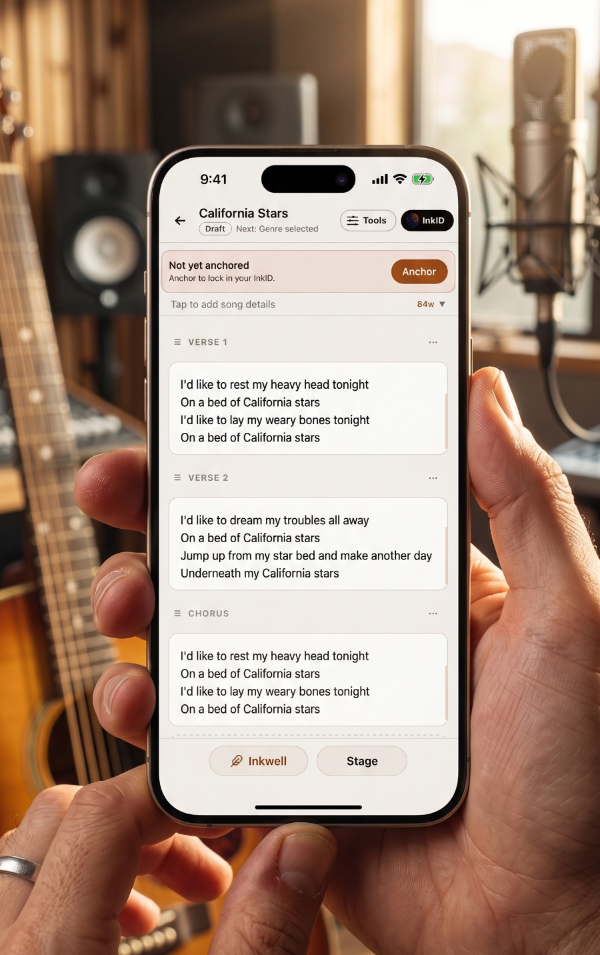
While you write, InkWave records the editorial process — the depth of revision, the topology of deletion, the way a line gets reshaped between pause and resolution. The capture is invisible to the writing itself. There is nothing to enable, nothing to remember, nothing that interrupts the song.
The methodology — what each dimension captures, how it activates, what kind of evidence it produces — is public.
The per-author weighting, calibration, and combination that produce each individual record are not.
A protocol that depends on its math being secret has already lost. A protocol whose math is published and whose key is private has the same defensibility as cryptography itself.
The line that arrives. The protocol that was there.
A song begins in a place no one else can see. The line at the stoplight. The chord progression that will not leave you alone. The verse that wrote itself between hour three and hour four of the writers' room, while everyone else was getting coffee. The songwriter is the only witness to the moment a song becomes itself — and historically, the world has only ever seen what came after.
That has always been the songwriter's quiet problem. The work is finished by the time anyone else can see it. The proof of the work — the drafts, the fragments, the false starts that finally got somewhere — exists in the songwriter's head, on their phone, in a notebook nobody will ever read. And when a co-writer remembers it differently, or a publisher claims a line was theirs all along, or a stranger on the internet says the lyrics sound a little too clean to be human — the songwriter is defending a moment no one else was in the room for.
InkWave was in the room.
Not as a witness in the legal sense. As a recording surface that was there while the writing was happening. Every pause before the line. Every revision after. Every dead end you explored before the chorus arrived. Every co-writer signed in their own hand. Captured during, anchored permanently, resolvable from outside the app by any publisher, lawyer, or collaborator who needs to see.
You wrote the song. You have always known it. Now everyone else can know it the same way you do — by the record, not by the argument.
The song is yours. The proof was being written. The record holds.
InkWave is a songwriting app that happens to anchor every session. The protocol is the substrate. The writing is the point.
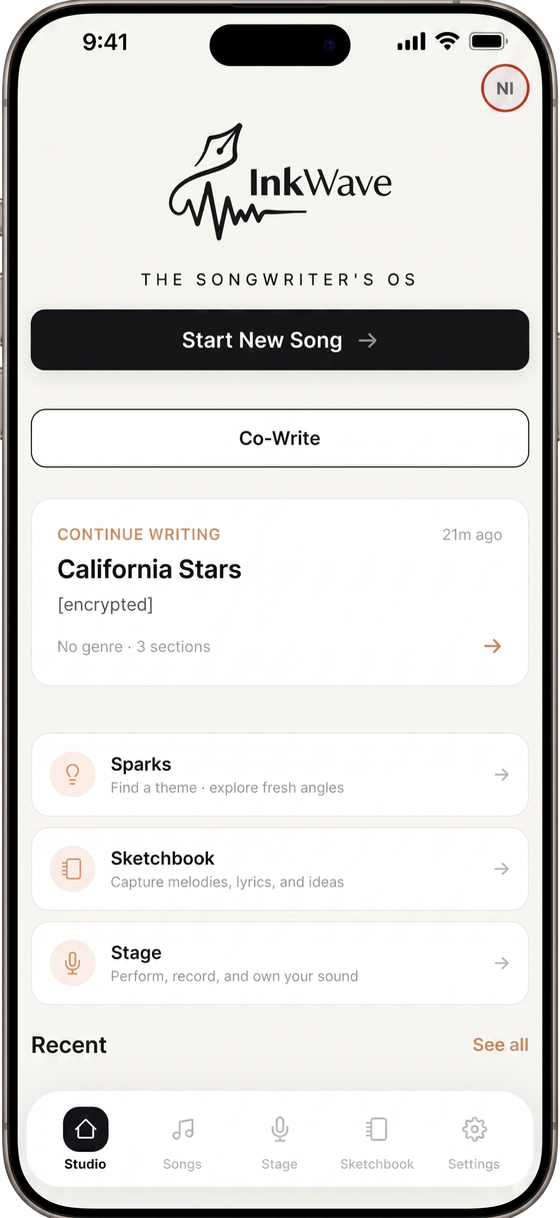
A block-based editor that knows what a verse is, what a chorus is, what a bridge is. Rearrange, label, rewrite at the section level. Per-block authorship is captured as you go.
A performance-mode display for taking what you've written into the room. Cards view for working a section at a time. Sheet view for full reads. Designed for the writer's chair and the desk reference both.
If anybody asks who wrote this
the answer's in the way I wrote it
— hold the line, hold the line —
An idea bank for the fragment that arrives unannounced — a melody hummed into your phone, a line typed at a stoplight, a chord progression noted between meetings. Captured, tagged, searchable.
A built-in recorder for takes, demos, and references. Three-second count-in, quick redo.
"Who wrote what" is one of the oldest arguments in songwriting. The split sheet — a piece of paper signed at session's end — has been the industry's answer for a century. It is, often, the only answer. And it is, often, wrong by the time anyone consults it.
InkWave's Co-Write mode captures authorship at the block level, in real time, across every co-writer in the session. Each writer signs in with their own InkID identity. Every line, every section, every revision is attributed to the person who actually wrote it. The split sheet generates from the evidence — not from negotiation.
When the session ends, every co-writer leaves with their own copy of the cryptographically signed record. Independently verifiable. From outside the room. Years later.
Smart Blocks know which co-writer drafted each section, which one revised it, which one cut a line that got reinstated. The whole creative motion of a co-write is recorded — not summarized.
Each co-writer signs the session with their own cryptographic key. No platform-mediated trust. Every contribution is anchored to a specific InkID identity, and every writer leaves with their own verifiable record. InkWave is not the source of truth — the writers are.
Some songs get finished across cities, time zones, and weeks. InkWave merges multiple sessions, on multiple devices, by multiple writers, into one unified record. No one loses their attribution because the room dispersed.
A writer who spent forty minutes exploring a direction that got abandoned did the work. The exploration is recorded and attributed even when the final song doesn't reflect it on the surface. Songwriters know what this means.
At session end, InkWave produces a split sheet reflecting actual contribution. Writers can override the percentages for negotiation reasons; they cannot override the underlying evidence. The split sheet links back to its source InkID record, resolvable by any publisher's legal team, on demand, from outside the platform.
Co-writes are how songwriting careers begin. Two friends, a guitar, a notebook. The discipline of attribution from day one — even on songs that go nowhere — builds the habit that matters later. And if one of those early songs ever does go somewhere, the record is already there.
Free-tier co-writes include basic per-writer attribution and the verifiable session record. Pro adds per-block attribution, generated split sheets, asynchronous merging, and dead-end attribution.
Every session produces an InkID — a publicly resolvable record of the behavioral evidence, anchored with an independent RFC 3161 timestamp. The record is private by default. You choose what publishes.
A PDF artifact suitable for split sheets, publisher submissions, and contract attachments. Signed, timestamped, and linked back to its live InkID record.
Generated from session attribution when there are co-writers. Per-section authorship reflects what actually happened in the room.
One self-contained file built on your phone: the recording, the lyrics, the cover, and the InkID record if you choose to include it. You send it yourself, so the recording never passes through our servers.
Multi-writer sessions captured in parallel. Each contribution attributed at the section level. Splits agreed and signed before anyone leaves.
Parallel capture across every writer in the session.
Section-level attribution — verse, hook, bridge.
Splits signed in-session, before anyone leaves.
Co-writes don't fall apart later — because they were never assembled later.
The demo doesn't disappear into an email thread. It arrives in your InkTrust workflow with the full demo kit attached:
The demo arrives verified.
Keystroke-level timing. Voice biometrics or voiceprints. The content of any session you have not chosen to anchor.
The session evidence bundle (anchored). Recordings (on-device by default; uploaded only with consent and classification). Documents you have generated.
Cryptographic erasure on revocation — the record's underlying evidence is destroyed in a way the protocol can attest to. The anchor token remains as a verifiable receipt of what was once there.
The record travels with the song. Through the co-write. Across the publisher's desk. Into the split sheet. Into the contract.
Per-section authorship is captured at the block level. The split reflects what actually happened in the room — not who shouted loudest after.
Free, for the writing itself. The protocol respects the work whether the record is needed or not.
For organizational catalogue management, see InkTrust.
InkTrust →InkWave launches first on iOS. iOS is in pre-launch testing now, and the public App Store release follows. Android parity is in active development and ships once iOS is stable in the App Store.